


What ANI Media v. OpenAI Reveals About How Large Language Models Really Work
I. Introduction
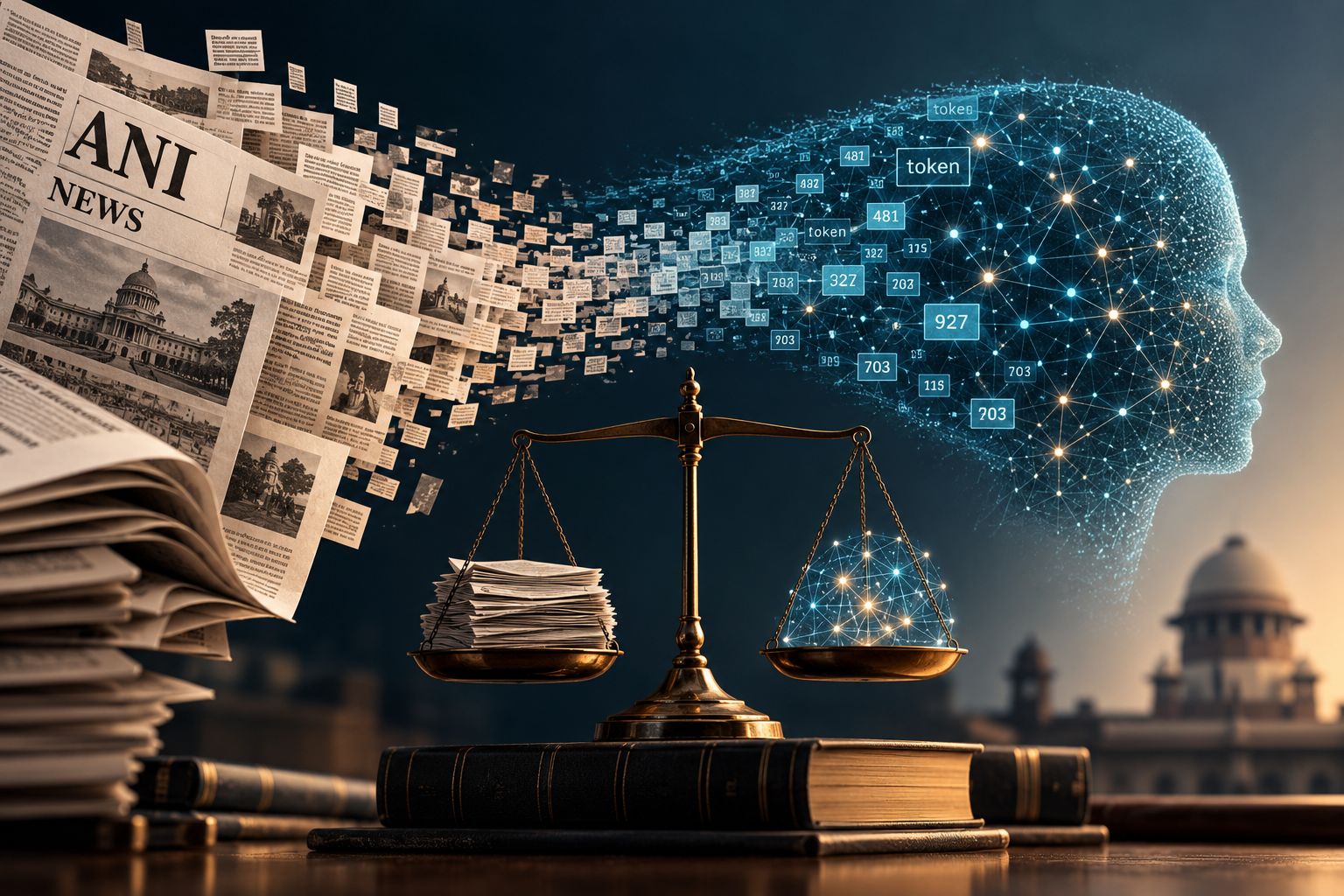
The Delhi High Court on 24 July 2026 delivered its ruling in the application filed by ANI Media seeking an interim injunction against OpenAI[i], India’s first major court decision to address the copyright issues arising from large language models (“LLMs”). The case, CS(COMM) 1028/2024, is not just a copyright case, but also provides an explanation of the way LLMs work. Justice Amit Bansal first had to explain on the record what an LLM is and how it works before determining whether training ChatGPT with ANI’s news articles violates their copyright or whether ChatGPT’s answers simply reproduce them.
That makes the case worth reading carefully, as the arguments on both sides rely on specific, testable technical claims: What is a ‘token’? Is a vector database a copy of anything? Does a chatbot ‘remember’ the text it was trained with? And why can the same prompt yield two different answers? This article addresses those technical claims and the legal issues upon which they were based and then discusses the doctrine that rests on top of the technology as the Court did.
In simple terms, generative AI are machine-learning models that learn patterns from data and generate new text, images, music, and so on that resemble human expression.[ii] Law professor Matthew Sag appeared before the U.S. Senate and said this: “We’re a long way from the science fiction of artificial general intelligence that thinks and feels, and refuses to ‘open the pod bay doors’ … but we now have large language models (LLMs) that can pass the bar exam, carry on a conversation about virtually any topic, compose new music, and produce new visual art.”[iii]
The ability to do such things is a concern of real-world applications: AI tools can be used to propagate misinformation, generative AI can replace human work in legal writing, graphic design, and other professional roles, and, less obviously, the current models could be the first of far more capable systems with interests that are not necessarily aligned with our own. Copyright is a significant part of these discussions, because it affects the very foundation on which generative AI is built, and it is the one with the most legal momentum: generative AI is, by its nature, copy-dependent, and it can’t be developed without first copying a massive amount of pre-existing text. That one point is what made a case on news articles and a chatbot into a 135-page opinion on the nuts and bolts of machine learning.
The difference between the two claims is important because it underlies all that follows: a training claim, which was that copying and storing ANI’s articles for use in training OpenAI’s models constituted copyright infringement, and an output claim, which was that ChatGPT’s responses to user prompts were ANI’s “expression” even when they weren’t the actual words of the articles. Part II of this article outlines the technical basis on which the Court relied for both claims. The doctrine of copyright is outlined in Part III. The case foundation is then built on the case itself in Parts IV through VIII: jurisdiction, output claim, training claim and fair dealing, and the balance of convenience.
II. How a Large Language Model Works
The fundamental essence of an LLM is that it is a computational system designed to anticipate the next word in a sequence of words. The basic language model is a distribution over words that might follow a prefix, and all other things it seems the model does is developed from that single operation.
A. Training Data: Collection, Filtering, and Tokenization
The first step when training a language model is to assemble a large text corpus, usually hundreds of billions of words[iv] of public information from the Web, and sometimes of licensed information. The data is screened for quality and safety before training is initiated; automated tools evaluate documents for usefulness and reliability, sometimes by comparing them to trusted sources like books, and extra screening is followed by filtering of material that includes personal information, adult material, or toxic language.
The data is then converted into tokens: numbers representing words, word fragments or punctuation. This is called tokenization, and can be as simple as splitting words into text, or a more complex operation like lemmatization or stemming. The mapping is lossless, meaning that encoding a string of tokens and then decoding it back to a string of tokens will recover the original string[v], a technical detail with legal implications: The numeric tokens are, in principle, also covered by copyright law, because they can be converted back to the original string. While tokenization is a key initial stage in the process of transforming text into numbers, it is not enough for most contemporary applications of AI, which construct more sophisticated and dense models of word and concept associations based on it.
B. What Word Prediction Teaches a Model
Consider a few examples of the kind used to illustrate this point:
- With roses. dahlias, and peonies, I was surrounded by __________ (flowers).
- The room wasn’t just big, it was __________ (enormous).
- The square root of 4 is ____ (2).
- The author of ‘A Room of One’s Own’ is __________ (Virginia Woolf).
- The professor said that ____ (he).
They all exhibit a different type of knowledge that can be gained from learning to predict the next word, such as knowledge that roses, dahlias, and peonies are all flowers, that ‘enormous’ is a more intense synonym of ‘big’, mathematical relations, and factual/historical. A danger of the approach is that a model that is trained on such relations can be infused with bias, as when it defaults to using a male pronoun for ‘professor’.
Selection of the token is not random for each step. The model assigns a raw score, also known as a logit, to every word in its vocabulary; the higher the logit, the more likely the model thinks that word will be the next one, and a mathematical function called a softmax turns those logits into a probability distribution, ranging from 0 to 1 and totalling 1. The logits are initial predictions by the model, while the output of the softmax provides the final probabilities for selecting the next word.
C. From Tokens to a Trained Model
After being deduplicated, filtered and tokenized, the data is entered into the model and used to train it. The model, which consists of billions or trillions of parameters, all starting from some initial value, is given a sequence of tokens and asked to predict the most likely next token. As the model’s predictions are checked against the data, its parameters are tuned in a way that makes it more likely to predict the next token in the future. Over many iterations, the model becomes more accurate. That is why it is referred to as a ‘pre-trained’ model, the ‘P’ in generative pre-trained transformer (GPT). No matter what a model like GPT-4o seems to be doing, its one and only use is making predictions. When a new token is generated, it’s inserted into the model, which then predicts the next one and when the next token is generated, it’s added to the model which then generates the next one, and so on, making prediction into generation. There are two things of importance with this first phase of training that are important for what comes next. In the United States, transferring internet-provided copyrighted material to a server to be stored for any reasonable period of time amounts to reproduction. Second, as pointed out above, the process of converting text to numerical tokens is of itself, in principle, an act which falls under copyright, since it is lossless and reversible. But these are not intended to be read or seen by any human being, which becomes all important as the Delhi High Court discusses the ‘private use’ defence in Part VII below.
D. Retrieval-Augmented Generation (RAG)
A different technique, called Retrieval-Augmented Generation, or RAG, which involves using a language model together with an external source of knowledge, in this case, a news agency’s live website, to retrieve information relevant to a user’s query using information-retrieval techniques to identify relevant documents. RAG output is not based on the model’s training dataset or the parameters of the model; instead, it is produced by the model’s language capability, along with the content retrieved from an external source based on the provided prompt. This separation between the learning that happens in pre-training and the retrieval that happens at query time is dispositive of ANI’s output claim, as discussed in Part VI below.
III. The Copyright Framework
Most LLMs are trained on datasets with a high proportion of copyrighted material, as a lot of text is needed to get useful results. Section 13(1)(a) of the Copyright Act, 1957 provides that copyright subsists in ‘original’ literary, dramatic, musical and artistic works. The Copyright Act does not define originality; the Supreme Court has held that a work is original if it is the product of the author’s skill and judgment, which must not be trivial, and not merely of labour and capital.[vi] The author of a work is the first owner of the copyright in it (Section 17), subject to the provisos to that section (for example, the one on works made in the course of employment with a newspaper proprietor), and the owner holds the exclusive rights under Section 14, including the right to reproduce the work.[vii] There are some training materials that are not, or no longer protected, works whose copyright term has expired, or government works but a lot of it is clearly protected. New technology is not exempt from copyright law because it is new. In the case of the LLM, two exclusive rights under Section 14 of the Copyright Act[viii] are potentially involved: (a) the right of reproduction under Section 14(a)(i), which extends to the storing of a work in any medium by electronic means and allows the owner to control the making of copies, and (b) the right of adaptation under Section 14(a)(vi), read with the definition of ‘adaptation’ in Section 2(a) (which, in clause (v), covers any use of a work involving its rearrangement or alteration), a right that is also recognized by instruments like the Berne Convention and described in the United States as the right to prepare ‘derivative works’, and which allows the owner to control a work’s transformation into a different form of expression.[ix] In order to assess infringement, it must be first determined whether the training data was improperly copied, adapted or otherwise used in a derivative of a protected work, and whether the trained model itself is a copy or an unauthorized adaptation of a protected work.
A. The Idea-Expression Dichotomy
The Copyright Act, 1957 contains no provision that expressly states the idea-expression dichotomy; Indian courts have drawn it from the scheme of the Act, under which copyright subsists in ‘original’ works (Section 13(1)(a)) and the exclusive rights in Section 14 attach to the work or a substantial part of it, and not to the ideas that it conveys.[x] The Supreme Court stated the principle in R.G. Anand v Delux Films, holding that there can be ‘no copyright in an idea, subject-matter, themes, plots or historical or legendary facts’, so that infringement is confined to the form, manner, arrangement and expression of the idea.[xi] In Eastern Book Co v D.B. Modak, which concerned the publisher of the SCC law reports and the copy-edited versions of Supreme Court judgments that it produced, the Court applied the same reasoning to facts and information: the Copyright Act is ‘not concerned with the original idea but with the expression of thought’, and there is no copyright in facts as such.[xii] The Delhi High Court has also recognised the merger doctrine, under which an expression that cannot be separated from the idea or fact it conveys is not protected, since protecting it would give a monopoly over the idea itself.[xiii] In ANI Media, the Court relied on these authorities to hold that, in the context of news, copyright subsists only in the form and manner of expression and not in the underlying facts.[xiv]
Globally, the most basic restriction on the extent of copyright protection is the idea-expression dichotomy. Ideas and functional elements of a work are not protected by copyright but only the manner in which the creator expresses the ideas.[xv] It is not a policy add-on, it is a structural element of copyright law, one which the United States Supreme Court has considered a part of what makes copyright “compatible” with the First Amendment,[xvi] in the United States to stop anyone from claiming a whole concept or genre. The concept of a painting of a comet over a beach at sunset is not protected, only the specific rendition of that concept is protected. When there are only a few ways to express an idea, courts have refused to grant protection at all, for fear of enclosing the idea within a fence.[xvii]
The dichotomy correlates with generative AI in a relevant fashion for what comes next. If a user provides the story parameters to ChatGPT, or tells the music model what he/she wants it to create, then the user is responsible for the idea, and the AI system is responsible for the words or notes. This introduces a structural issue, where the ‘creative element’ is largely provided by the system and not the human, this might not be part of copyright protection at all, although the concept that copyright can be granted where one party contributes ideas and the other performs them is not novel.
B. Substantial Similarity, Access, and What Generative AI Complicates
In India, the test for infringement is drawn from the Supreme Court’s decision in R.G. Anand v Delux Films, which concerned a claim that a film had copied the plaintiff’s play. The Court held that where the same idea is developed in a different manner, similarities are bound to occur, so that the question is whether the similarities are on fundamental or substantial aspects of the mode of expression, such that the copy is ‘substantial and material’. One of the tests it identified is whether a reader or viewer, after going through both works, gets an ‘unmistakable impression’ that the later work is a copy of the original; and where there are also material and broad dissimilarities, and the coincidences are incidental, no infringement arises.[xviii] The comparison is of the works as a whole and not of selected extracts.[xix] The U.S. position, which the rest of this Part uses to show what generative AI complicates, is framed differently.
In the United States, copyright infringement traditionally demands a plaintiff prove two elements: first, that the defendant copied from the plaintiff; and second, that the defendant copied more than a de minimis amount of protectable expression.[xx] Courts have long recognized that copying can be implied from access and similarity,[xxi] and access to published works is virtually universal these days online, so in the Internet era, the question that seems to come down to is how similar are the two works?[xxii]
Generative AI upsends that shortcut. When two users give an AI system the same or a similar prompt, for example, ‘impressionist painting of penguins having a picnic at a beach’, the images generated are likely to be different, as they are based on the parameters of the AI system, the prompt, and a random seed.[xxiii]
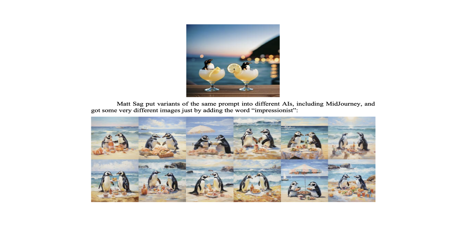
This similarity does not mean a copy of protectable expression. A prompt is just an idea and the similarity is either because of the common notion or because of the internal model of the concept that the AI system has. The fact that a prompt is closer to a particular work in the training set does not necessarily mean that a protected element was copied, as it may also mean that the work was independently converged upon based on the same or similar prompts, or that the work was generally convergent in the training set.
This changes the focus of the pertinent question from output similarity to quick access. Independent creation is a total defence, even if two works created are identical.[i] Unlike finished works, prompts are not generally published, and the same loose ‘ubiquity of the internet’ reasoning that courts apply to finished works cannot be extended to access to another party’s prompt, where there is no credible explanation of how the alleged accessor obtained the prompt. Even if a prompt has been copied and is itself sufficiently creative to be protectable, a plaintiff must also demonstrate that what was copied from the output is the prompt expressed in that specific manner, rather than the unprotected ideas or AI-generated expression that make up the bulk of any generated work[ii] an even more difficult burden, which also leaves room for a second defence. A person who independently reverse-engineers a new prompt to arrive at a similar result has not copied anything protectable, since only the prompt itself, not the resulting image, falls within the scope of copyright.
The idea–expression dichotomy, the substantial-similarity test (as applied in India under R.G. Anand), and the complication ChatGPT brings to both of these doctrines are the very tools the Delhi High Court used to determine whether the answers it provided to questions regarding ANI were a reproduction of ANI’s protected expression, as discussed in Part VI below.
IV. ANI Media v. OpenAI: Factual Background and Issues Framed
ANI is an Indian news agency which produces original news articles, interviews and reports, which are distributed to subscribers and published on its website and social media. Prior to the litigation, ANI had made an offer to OpenAI to license its content for USD 7.5 million, which the Court subsequently considered when determining damages and the balance of convenience.[iii] ANI’s claim was based on the training claim and the output claim of Part I, including the allegation that ChatGPT had made up quotes that it attributed to ANI.
The Court framed four issues, the first of which, the jurisdiction (Issue 4), is discussed below, followed by the output/response claim (Issue 2), and then training/storage claim (Issue 1), and fair dealing under Section 52 of the Copyright Act, 1957 (Issue 3), which the Court treated together with Issue 1.
V. Jurisdiction
OpenAI stated that training happens on U.S. servers with data sourced outside of the United States and that the Copyright Act, which doesn’t have an extraterritorial effect, doesn’t apply to the training claim. In addition, OpenAI noted that the terms of use of ChatGPT would give San Francisco courts jurisdiction over the output claim. ANI and a few intervenors (the Digital News Publishers Association, the Indian Music Industry and the Federation of Indian Publishers) argued that the jurisdiction is not dependent on the location of the server (the intervenors relying on the ‘purposeful availment’ test in Banyan Tree Holding (P) Ltd v A Murali Krishna Reddy[iv]), that Section 20 of the Code of Civil Procedure, 1908, would also be satisfied as OpenAI actively sought Indian subscribers and payments, and that a contractual forum-selection clause cannot be used to prevent a statutory jurisdiction provision.
The Court accepted the arguments of ANI on both counts. On territorial jurisdiction, ANI’s registered office and principal place of business is in Delhi, which confers territorial jurisdiction under Section 62(2) of the Copyright Act, 1957, and it was not disputed that OpenAI specifically targets users and subscribers across India and that the allegedly infringing responses were generated in India. On the application of the Copyright Act to the training claim, OpenAI relied on Blueberry Books v. Google India,[v] a Division Bench decision in which Amazon had argued that the infringing acts took place only in the United States, an argument that the Division Bench did not accept. The Court held that the storage of ANI’s works on U.S. servers was the terminal step in a chain of events that began with the access and transmission of ANI’s copyrighted material from India, and that the Copyright Act does not require the Court to sever that chain and examine only the last step, since otherwise an infringer could circumvent the Act by shifting storage to servers abroad. In doing so, the Court drew on Neetu Singh v Telegram FZ LLC,[vi] where a Coordinate Bench held that a platform’s choice to locate its servers in Singapore did not leave Indian copyright owners without a remedy. The Court also rejected the severance of training claim from the output claim as both claims are factually connected by the fact that the output is produced in India.
Holding: The Court has territorial jurisdiction over the training claim and the output claim at the prima facie stage, and the application of the Act to the training claim is not impermissible extraterritorial application.
VI. The Output Claim: Does ChatGPT Reproduce ANI’s Work?
The Court posed two sub-issues to Issue 2: (i) whether ChatGPT memorises and regurgitates ANI’s work and (ii) whether the answers that it gives are substantially similar to ANI’s work without memorisation.
A. Memorization and Regurgitation
ANI’s position was directly based on the technical picture outlined in Part II: LLM’s must learn and, in some sense, ‘remember’ their training data; OpenAI’s admission that its models sometimes ‘regurgitate’ the text of their training data; and the Copyright Act have no outline distinction between ‘expressive’ use of a work reproducing or communicating its protected expression and ‘non-expressive’ use extracting facts, patterns or statistical signal, such as grammar or correlations.[vii]
OpenAI’s rebuttal was that the training cut-off dates of the relevant models were April 2022 (GPT-4) and April 2024 (GPT-4o), and that all fourteen ANI works cited as ‘infringed’ were published after those cut-offs and so could not possibly have been part of the training data. OpenAI further submitted that an LLM, as described in Part II.C, does not retain or access training data after pre-training; that grammar and syntax are not being monopolised; and that the facts in the news are not protected, only the specific expression used to convey them.[viii] It also submitted that Indian law rejects the ‘sweat of the brow’ doctrine in favour of a ‘skill and judgment’ threshold for protectable expression,[ix] and that any comparison should be of the works as a whole and not of extracted portions[x], in line with the holistic-comparison principle outlined in Part III.B above.
The Court also evaluated Local Media LLC v. Cohere Inc.,[xi] a U.S. motion-to-dismiss decision relied on by ANI, but distinguished it on the basis that the plaintiff pleaded seventy-five instances of copying, allegedly fifty of them were verbatim, which was a much stronger factual showing than ANI had made here, in contrast to ANI’s citation of mere instances, and ‘hallucination’, a model that produces false but fluent sounding content, was also noted in the technical preface as a limitation of the LLM safety and not pleaded facts before the Court.
The Court found that each of ANI’s nine plaint illustrations was published after the relevant model’s training cut-off date. Applying the RAG concept explained in Part II.D, the Court found that these outputs identified by ANI were not retrieved from the memorized training data, but instead were retrieved live from ANI’s public website at the time of the query.[xii] The Court declined to adjudicate RAG-based infringement at this stage as it was not even pleaded in the plaint.[xiii]
Holding: At the prima facie stage, there is no evidence of memorization or regurgitation of ANI’s works by ChatGPT; rather the cited examples are RAG sourced and post-date training.
B. Substantial Reproduction Without Memorization
Even if you don’t consider memorization, ANI argued that ChatGPT’s results were highly similar to its protected expression. In this case, the Court adopted the doctrine outlined in Part III.B: ideas, facts and themes are not protectable; comparison must be of the copyrightable expression as a whole; the test is whether the ordinary reader or viewer is given the ‘unmistakable impression’ of copying; and dissimilarities, combined with only superficial similarities, are enough to defeat a claim.[xiv]
The lawyers for OpenAI said ChatGPT does not copy and paste ANI’s content, but paraphrases, summarizes, and interprets it, sometimes adding context or commentary “referential use” or “interpretive synthesis” but never the same content “in material form” required to invoke Section 14A. For example, ANI had quoted Neeraj Chopra’s mother as saying, ‘Arshad bhi mera beta hai’ where ChatGPT’s response was ‘the one who got the gold is also like our son’, which counsel argued was not a copy, but an interpretation.[xv]
The Court noted that the content in the article was much longer than the ChatGPT generated quote, which was only a brief excerpt of the interviewee’s own work, whose copyright, if any, belonged to her and not to ANI, and that ChatGPT added its own interpretations. The Court also noted that the foreign authorities on which ANI relied were not the same: in GEMA v. OpenAI,[xvi] memorization was found to occur only when the non-adversarial prompts reproduced the song lyrics verbatim, whereas in ANI’s case, prompts were adversarial and did not yield verbatim song lyrics, Cohere involved a much stronger pleaded factual record, and Positive Black Talk v. Cash Money Records,[xvii] a music case, was inapplicable because of the lower creativity and higher fact-content profile of news reporting.
Holding: At the prima facie stage, there is no evidence of memorization or regurgitation, and when considering the ChatGPT outputs as a whole as compared to ANI’s works, there is no evidence of substantial reproduction. ANI was unable to prove infringement of the output claim.
VII. The Training Claim and Fair Dealing Under Section 52
The Court expressly merged Issues 1 and 3, on the view that Section 52 is not a standalone exception bolted onto Sections 14 and 51, but an integral qualifier: an act only becomes ‘infringement’ under Section 51 if it is not saved by Section 52.
A. Storage as Reproduction Under Section 14(a)(i)
The term reproduction shall mean the storage of a copy of a reproduction, as defined in Section 14(a)(i).
ANI’s stance was in line with the technical account in Part II.A and II.C. Collecting raw data, tokenizing it, and encoding the tokens into a vector database are all storage, reproduction, or adaptation under Sections 14(a)(i) and 2(a)(v), training necessarily involves storing the expression, not just the facts; and the expression is ‘reflected in the model’ whenever it is fed into the model and will be reflected in the model’s output forever after. Interveners DNPA, IMI and FIP argued in support of this reading, based on the fact that Section 14(a)(i) (‘any medium’ and ‘any material form’) is deliberately broad, no distinction is made between expressive and non-expressive uses, and no Indian exception for text and data mining exists similar to EU law.
Again in the light of the technical picture presented in Part II, OpenAI’s answer was that the information stored is not human-readable, but rather intermediate, a vector database that’s similar to a dictionary used to extract non-expressive elements like grammar, syntax, and pattern; that ANI’s content is a small fraction of the overall training data and that after training is complete, the model no longer has access to the information, consistent with the point made in Part II.C that an LLM is not storing or accessing its training data after it has been pre-trained.
The Court concluded that the 1994 amendment adding ‘including the storing of it in any medium by electronic means’ to the reproduction right is intentionally broad and it does not make any distinction between temporary and permanent storage and a defendant’s intention or purpose is not relevant to whether Section 14(a)(i) is triggered at all. This is where the judgment turns, however in Section 14 itself is expressly ‘subject to the provisions of this Act’ including Section 52. While storage may be covered by Section 14(a)(i) in the abstract, but whether it amount to infringement under Section 51 depends entirely on whether Section 52 saves it.
B. The Two-Step Test: Purpose and Fairness
Tracing the legislative history of Section 52(1)(a) from ‘research or private study’ (1957) to ‘private use, including research’ (1994, which had been described as ‘unduly narrow’ and capable of causing ‘harassment to the public’) to ‘private or personal use, including research’ and a new Explanation on electronic storage (2012), the Court saw a clear legislative trend to expand, never restrict, the fair-dealing carve-out, and therefore rejected ANI’s request for a narrow, exception-style interpretation of it.
The Court then applied a two-step test: purpose test (does the use fall within private/personal use, including research, criticism/review, or reporting of current events under Section 52(1)(a)(i)–(iii)?) and fairness test (is the dealing nonetheless ‘fair’?).
On purpose, ANI raised three objections to OpenAI’s S.52 defence. First, does the defence apply to commercial use? The Court said it does not: the legislature explicitly added the words “commercial use” only in certain clauses (S. 52(1)(ad), (k)(ii), (l), (n), (o)), and did not add the words “commercial use” in Section 52(1)(a) itself. The Court also drew parallels with CCH Canadian Ltd. v. Law Society of Upper Canada,[xviii] where even a for-profit legal research constituted ‘research’ under the pari materia Canadian provision, and contrasted ANI’s authorities with ones in which the defendant had provided infringing material to third parties,[xix] but not in OpenAI’s case where its training data never reached any third party in any form.
Second, does the copy stored need to be a ‘non-infringing copy’? In reading carefully the wording of the 2012 Explanation, the Court concluded that the ‘not itself an infringing copy’ qualification is limited to incidental storage of computer programmes and does not apply to literary works in general, thus comparing the case of a researcher photocopying a library book to a researcher who makes an electronic scan of the same page for the same purpose. As for ANI’s content, it was available on ANI’s website without a paywall, so even on ANI’s more conservative interpretation, the content copied was not ‘infringing’ in the first place.
Third, is OpenAI’s actions ‘private or personal use, including research’? The Court’s interpretation proceeded in three steps. The Court did not accept a ‘private’–‘personal’ argument that would render ‘private’ synonymous with ‘personal’ and found that OpenAI’s training corpus, per the dictionary definition and in B. Malini Mallya, extending ‘private use’ to a closed group, company, or entity where the material is inaccessible to any outside human, is ‘purely private’. The word ‘research’ was interpreted broadly and liberally in Blackwood v. A.N. Parasuraman[xx] and CCH Canadian, and the Court considered LLM training to be a ‘knowledge-generating process’ similar to what is done before a student engages in scholarly or professional research, where the end product of the process is the trained model, rather than the data used to train it, that is communicated to the public. Lastly, the Court stated that the ‘doctrine of updating construction’ meant that Parliament in 2012 would not have been able to have foreseen LLMs, and therefore ‘research’ does not have to be conducted by a human researcher and can be conducted by machine learning as long as it is done on the instructions of and for the benefit of humans.
The purpose test is satisfied; holding: OpenAI’s storage of ANI’s works for training LLM is for private or personal use, including research, under Section 52(1)(a)(i).
On fairness, the Court observed that there is no single established Indian test for ‘fair dealing’, and the U.S. four-factor test is not applicable to Indian law, which it termed as ‘purpose-limited’ and not ‘purpose-agnostic’; and thus formulated its own three-factor test: (a) whether OpenAI’s use of ANI’s works was limited to training and not diverted to any other purpose; (b) whether it caused economic competition, prejudiced ANI’s legitimate interests, or caused actual or potential damage; (c) whether ChatGPT’s functioning served the ‘broader public interest’. Indian courts had earlier treated fair dealing as a question of degree and fact: in Civic Chandran v Ammini Amma,[xxi] the Kerala High Court, dealing with a counter-drama that criticised an earlier play, looked to the quantum and value of the matter taken in relation to the criticism, the purpose for which it was taken, and the likelihood of competition between the two works. Limb (b) of the Court’s test above, on competition and prejudice to the plaintiff, overlaps with the last of these considerations.
The Court used the above findings in Issue 2 which concluded that there was no memorization or regurgitation, and documentary evidence that was not rebutted to establish that the training material was only utilized to produce new responses in the first limb. On the second, the Court distinguished between ANI’s subscription and syndication business and ChatGPT’s use as a general-purpose tool for content creation, research, translation, education and summarisation, where news is just one narrow use case, typically as a sourced summary rather than a substitute for the full article; it heavily relied on the transformative-use reasoning of Bartz v. Anthropic[xxii] and Kadrey v. Meta Platforms,[xxiii] and did not find any facts pleaded that showed any market substitution or economic prejudice. On the third, the Court highlighted the extensive use of AI in society, particularly in education, research, healthcare, and accessibility, and India’s policy goals for the technology, referring to the NITI Aayog’s AI Roadmap for Inclusive Societal Development (October 2025).[xxiv]
It is held that both the purpose test and the fairness test in Section 52(1)(a) are met. OpenAI’s use of ANI’s literary works for training its LLM is not an infringement under Section 51 because it is done for the purpose of training the model and not for any other purpose. At the prima facie level, OpenAI’s storage of ANI’s literary works for the purpose of training its LLM does not constitute infringement under Section 51.
VIII. Balance of Convenience and Irreparable Injury
On the contrary to the above, considering all the submissions made before this Court and even assuming that a prima facie case existed, the Court held the balance of convenience decisively favoured OpenAI. The fact also cannot be ignored that ANI had itself offered OpenAI a licence for USD 7.5 million, which itself establishes that the claim made was quantifiable in the nature of money and compensable by damages should it succeed at trial. It also cannot be ignored that the ANI had the technical ability and could have anticipated blocking OpenAI’s crawlers through opt-out mechanisms and had chosen not to exercise that option fully. Also, it is to be noted that OpenAI had independently blocked ANI’s website for both training and RAG purposes, followed by no evidence being placed on record to substantiate the claim that ANI had actually lost subscribers or syndication revenue as a result of OpenAI’s activities. As it was observed by this Court earlier that it would harm millions of Indian ChatGPT users and would be detrimental to AI development in India, a harm not readily compensable in money.
IX. Conclusion
This decision provides the first significant judicial guidance on the application of Indian copyright law to AI training and offers a certain level of business certainty for AI developers operating in or targeting India. While declining interim relief to ANI, the Court left significant questions open for trial, including the scope of copying in AI training, whether memorisation or regurgitation may occur elsewhere, and ownership of individual works.
I find the Section 52 reasoning less settled. Reading “research” to cover machine learning, and “private use” to cover a company’s internal storage, is a generous interpretation. It rests on the interim stage, on ANI’s thin evidence of market harm, and on public interest. A trial with fuller evidence on memorisation, RAG and lost licensing revenue could change the outcome.
I find some gaps that need attention. First, a record of actual market harm and use opt-out tools such as crawler blocks. Second, the unpleaded RAG question is most likely to harm publishers. Third, if Parliament wants a settled answer on AI training, whether a licensing model or a text and data mining exception, it should legislate and not leave the question to judicial interpretation. In my point of view, the decision is more likely a first step towards the settled rule. The question remains unclear on whether India should adopt a licensing model or a text and data mining exception with a clear opt-out.
[i] Sheldon v Metro-Goldwyn Pictures Corp 81 F 2d 49, 54 (2d Cir 1936); Ty Inc v GMA Accessories Inc 132 F 3d 1167, 1169 (7th Cir 1997).
[ii] Satava v Lowry 323 F 3d 805, 807 (9th Cir 2003).
[iii] SCC Online, ‘Khaitan & Co Represents OpenAI in Landmark AI Copyright Dispute Before Delhi High Court’ (SCC Online Blog, 27 July 2026) https://www.scconline.com/blog/post/2026/07/27/khaitan-co-represents-openai-copyright-dispute-delhi-high-court/ accessed 10 August 2026.
[iv] Banyan Tree Holding (P) Ltd v A Murali Krishna Reddy 2009 SCC OnLine Del 3780 (Delhi High Court, Division Bench); see ANI Media Pvt Ltd v Open AI OpCo LLC (n 1) paras 36.5, 38.2 and 39.1.
[v] Blueberry Books v Google India Pvt Ltd 2016 SCC OnLine Del 3338 (Delhi High Court, Division Bench, 25 May 2016, arising from FAO(OS) No 297/2014) para 27; see ANI Media Pvt Ltd v Open AI OpCo LLC (n 1) paras 49–51.
[vi] Neetu Singh v Telegram FZ LLC 2022 SCC OnLine Del 2637, para 46, as quoted in ANI Media Pvt Ltd v Open AI OpCo LLC (n 1) para 52.
[vii] ‘Expressive use’ and ‘non-expressive use’ as defined in ANI Media Pvt Ltd v Open AI OpCo LLC CS(COMM) 1028/2024, paras 131.4, 134.1, 136.9 (see (n 1)).
[viii] Feist Publications Inc v Rural Telephone Service Co 499 US 340 (1991).
[ix] Eastern Book Co v D.B. Modak (2008) 1 SCC 1.
[x] R.G. Anand v Delux Films (1978) 4 SCC 118, AIR 1978 SC 1613.
[xi] Advance Local Media LLC v Cohere Inc No 1:25-cv-01305-CM (SDNY, filed 13 February 2025).
[xii] ANI Media Pvt Ltd v Open AI OpCo LLC (n 1) (describing Retrieval-Augmented Generation as the mechanism by which the disputed outputs were sourced from ANI’s live website rather than from training data).
[xiii] RAG-based infringement was not pleaded in the plaint; see ANI Media Pvt Ltd v Open AI OpCo LLC (n 1) para 124 (also noting that ANI could not point to a single actual instance of ANI-content regurgitation).
[xiv] R.G. Anand v Delux Films (1978) 4 SCC 118, AIR 1978 SC 1613.
[xv] ANI Media Pvt Ltd v Open AI OpCo LLC (n 1) paras 104–107.
[xvi] GEMA v OpenAI (Munich I Regional Court, 2025) 81(6) JZ 235 (2026).
[xvii] Positive Black Talk Inc v Cash Money Records Inc 394 F 3d 357 (5th Cir 2004).
[xviii] CCH Canadian Ltd v Law Society of Upper Canada 2004 SCC 13, [2004] 1 SCR 339.
[xix] Rupendra Kashyap v Jiwan Publishing House 1996 (16) PTC 439 (Del).
[xx] Blackwood and Sons Ltd v A.N. Parasuraman AIR 1959 Mad 410.
[xxi] Civic Chandran v Ammini Amma 1996 (16) PTC 329 (Ker).
[xxii] Bartz v Anthropic PBC No C 24-05417 WHA (ND Cal, 23 June 2025).
[xxiii] Kadrey v Meta Platforms Inc No 23-cv-03417-VC (ND Cal, 25 June 2025).
[xxiv] NITI Aayog and Deloitte, Roadmap on AI for Inclusive Societal Development (NITI Aayog, 8 October 2025) https://niti.gov.in/sites/default/files/2025 10/Roadmap_On_AI_for_Inclusive_Societal_Development.pdf accessed 12 August 2026.
[i] ANI Media Pvt Ltd v Open AI OpCo LLC I.A. 45300/2024 in CS(COMM) 1028/2024 (Delhi High Court, 24 July 2026) (the suit was instituted in 2024, which is why the case number carries that year; the interim injunction application was decided by the judgment pronounced on 24 July 2026).
[ii] ‘AI and Creativity: How Generative AI is Transforming Art, Design, and Content Creation in France’ (AceMoneyTransfer Blog) https://acemoneytransfer.com/blog/ai-and-creativity-how-generative-ai-is-transforming-art-design-and-content-creation-in-france accessed 9 August 2026.
[iii] Matthew Sag and Peter K Yu, ‘The Globalization of Copyright Exceptions for AI Training’ (2025) https://core.ac.uk/download/661126677.pdf accessed 9 August 2026.
[iv] Jordan Hoffmann and others, ‘Training Compute-Optimal Large Language Models’ (2022) arXiv:2203.15556 https://doi.org/10.48550/arXiv.2203.15556 accessed 9 August 2026.
[v] Juan Luis Gastaldi, John Terilla, Luca Malagutti and Brian DuSell, ‘The Foundations of Tokenization: Statistical and Computational Concerns’ (2024) arXiv:2407.11606 https://doi.org/10.48550/arXiv.2407.11606 accessed 10 August 2026.
[vi] Eastern Book Co v D.B. Modak (2008) 1 SCC 1, paras 15 and 57; see also ANI Media Pvt Ltd v Open AI OpCo LLC (n 1) paras 87–90.
[vii] Copyright Act 1957, ss 13(1)(a), 14 and 17.
[viii] Copyright Act 1957, ss 2(a), 14(a)(i) and 14(a)(vi); Berne Convention for the Protection of Literary and Artistic Works (as revised) arts 9 and 12.
[ix] T.G. Agitha, ‘Idea-Expression Dichotomy and Originality Requirements for Copyright Protection: An Analysis of the Jurisprudential Underpinnings of the Judicial Pronouncements in India’ in Manoj Kumar Sinha and Vandana Mahalwar (eds), Copyright Law in the Digital World: Challenges and Opportunities (Springer 2017) 1.
[x] Copyright Act 1957, ss 13(1)(a) and 14; see also Agreement on Trade-Related Aspects of Intellectual Property Rights (1994) art 9(2).
[xi] R.G. Anand v Delux Films (1978) 4 SCC 118, AIR 1978 SC 1613, para 46(1).
[xii] Eastern Book Co v D.B. Modak (2008) 1 SCC 1, paras 15 and 57.
[xiii] Syndicate of the Press of the University of Cambridge v B.D. Bhandari 2011 SCC OnLine Del 3215, as discussed in ANI Media Pvt Ltd v Open AI OpCo LLC (n 1) para 95.
[xiv] ANI Media Pvt Ltd v Open AI OpCo LLC (n 1) para 97.
[xv] K Greene, ‘Intellectual Property at the Intersection of Race and Gender: Lady Sings the Blues’ (2008) https://core.ac.uk/download/235405744.pdf accessed 10 August 2026.
[xvi] Mark Moldawer, ‘Publicity Rights Metamorphosis: From The Right to Evoke to the Ultimate Evoked Rights’ (2025) https://core.ac.uk/download/664340829.pdf accessed 10- August 2026.
[xvii] Morrissey v Procter & Gamble Co 379 F 2d 675, 678 (1st Cir 1967) (‘[When] the topic necessarily requires . . . if not only one form of expression, at best only a limited number, to permit copyright would mean that a party or parties, by copyrighting a mere handful of forms, could exhaust all possibilities of future use of the substance’).
[xviii] R.G. Anand v Delux Films (1978) 4 SCC 118, AIR 1978 SC 1613, para 46(2)–(5); see ANI Media Pvt Ltd v Open AI OpCo LLC (n 1) para 86.
[xix] ANI Media Pvt Ltd v Open AI OpCo LLC (n 1) para 108 (noting that R.G. Anand requires a comparison of the works as a whole and not of selected parts).
[xx] Arnstein v Porter 154 F 2d 464, 468 (2d Cir 1946) (distinguishing (a) copying from (b) improper appropriation as separate elements of a plaintiff’s case).
[xxi] Arnstein v Porter 154 F 2d 464, 468 (2d Cir 1946) (copying may be shown by admission or circumstantial evidence of access); Rentmeester v Nike Inc 883 F 3d 1111, 1124 (9th Cir 2018) (the ‘inverse ratio rule’).
[xxii] Skidmore ex rel Wolfe v Led Zeppelin 952 F 3d 1051, 1068 (9th Cir 2020) (en banc); but cf Clark D Asay, ‘An Empirical Study of Copyright’s Substantial Similarity Test’ (2022) 13 UC Irvine L Rev 35, 75.
[xxiii] Katherine Lee and others, ‘Talkin’ About AI Generation: Copyright and the Generative AI Supply Chain’ (2024) Journal of the Copyright Society Working Paper, 13.