



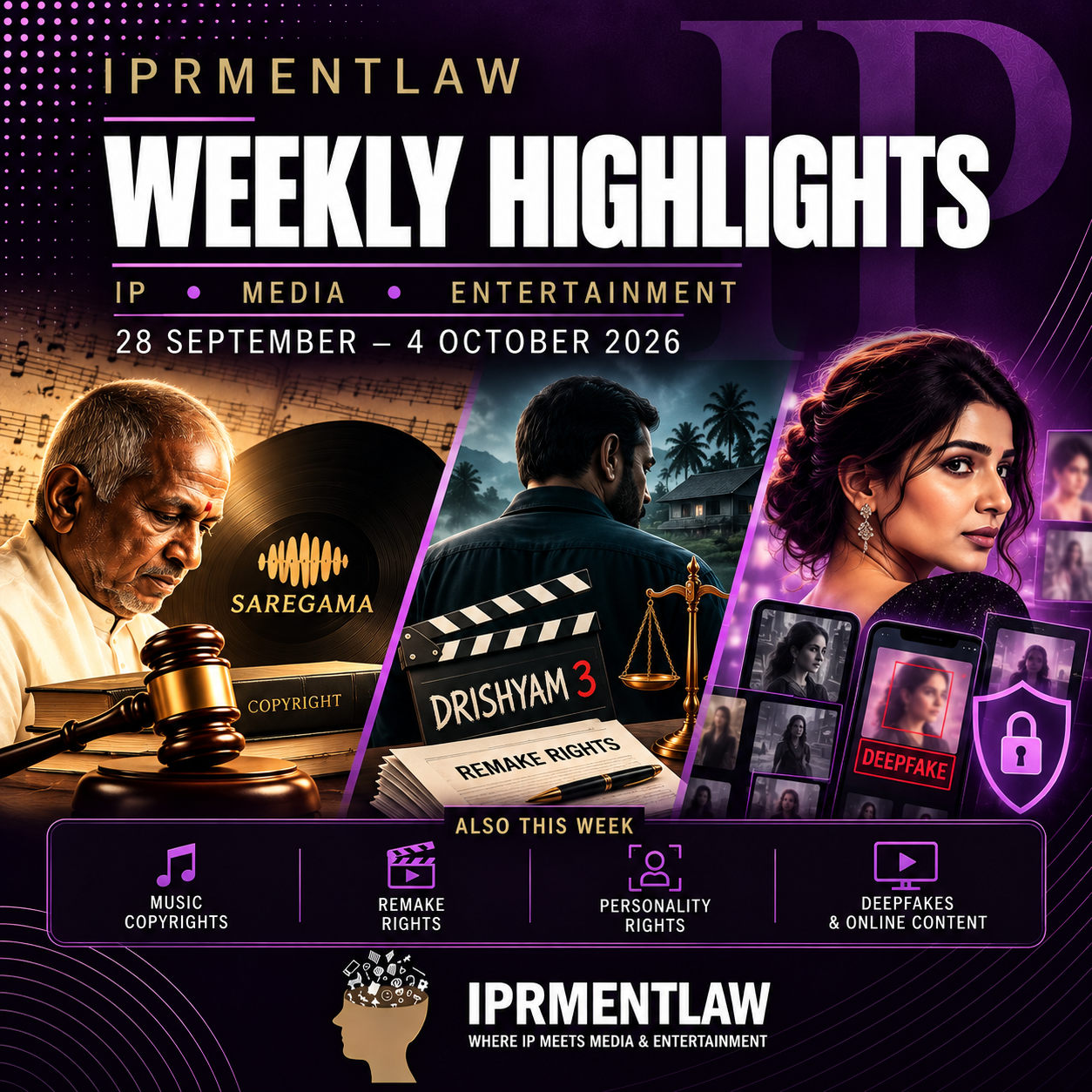
Supreme Court refuses to interfere with Delhi HC ruling that Saregama owns sound recording copyright in Ilaiyaraaja’s ‘En Iniya Pon Nilave’
On 1 October 2026, the Supreme Court refused to interfere with a Delhi High Court ruling that music composer Ilaiyaraaja did not own the copyright in the lyrics and sound recording of the song En Iniya Pon Nilave from the Tamil film Moodu Pani, and that the rights in the sound recording vested with Saregama.
A Bench of Justices J.B. Pardiwala and K. Vinod Chandran declined to entertain his challenge to the High Court’s order, which had dismissed his pleas against earlier rulings upholding an injunction in favour of Saregama.
The dispute arose after Vels Film International Ltd. recreated the song for its film Aghathiyaa, claiming to have obtained the necessary rights from Ilaiyaraaja. Saregama objected, asserting that it owned the copyright in the original sound recording through an assignment from the film’s producer.
The Delhi High Court had held that Ilaiyaraaja retained copyright in the musical work, being the tune or composition, but not in the sound recording or the lyrics, and that he could not assign to Vels rights he himself did not own.
The Division Bench affirmed the Single Judge’s injunction restraining the use of the recreated version in Aghathiyaa, holding that the copyright in the sound recordings of Moodu Pani, including the song, had vested with RCA, the original rights holder, and was subsequently transferred to Saregama under an agreement dated 25 February 1980. It held that the recreation or adaptation of the sound recording amounted to infringement of Saregama’s copyright.
Ilaiyaraaja had argued that, as the composer and author of the musical work, he remained the first owner of copyright in the composition, and that Section 13(4) of the Copyright Act, 1957 protected his independent copyright even after the composition was incorporated into a cinematograph film. The producers of Aghathiyaa relied on the rights allegedly obtained from him and contended that he was entitled to license adaptation of the musical work under Section 14(a)(vi). The Single Judge rejected these contentions and the Division Bench upheld the decision. The High Court dismissed his petition on May 26, prompting the appeal to the Supreme Court.
Madras HC refuses to block Hindi remake of Drishyam 3 in remake rights dispute
The Madras High Court has refused to restrain the release of the Ajay Devgn-starrer Hindi version of Drishyam 3, in a plea by Rajkumar Theatres Private Limited claiming that it also held rights to remake the Malayalam sequel in Hindi. Rajkumar Theatres had approached the Court under Section 9 of the Arbitration and Conciliation Act, 1996, seeking to block the worldwide release of the film across theatres, OTT platforms and satellite television.
Rajkumar Theatres claimed that, under agreements entered into in December 2013 with Ashirvad Cinemas and director Jeethu Joseph, Wide Angle Creations acquired Hindi and certain North Indian language remake rights, while Rajkumar Theatres funded the entire ₹50 crore consideration and the two agreed to share those rights equally. A June 2014 agreement allegedly recorded this arrangement and made the two equal joint owners of the copyright in the Hindi versions. The respondents opposed the plea, relying on a 2014 assignment to Viacom18 and 2022 settlement agreements to argue that the Hindi sequel and derivative rights had been assigned onward.
In his order of October 1, Justice K. Govindarajan Thilakavadi held that the material placed on record did not establish, at the interlocutory stage, “with sufficient clarity” that Rajkumar Theatres continued to hold an exclusive or joint copyright in the Hindi remake rights of Drishyam 3. The Court observed that a worldwide block on the film would have serious consequences for the respondents and for third parties claiming under later arrangements, and that such relief required clear material showing a subsisting and enforceable right under imminent threat.
The Court did not decide who finally owns the Hindi remake rights, noting that the rival claims under the various agreements and subsequent transactions require detailed adjudication.
Read order here.
Bombay HC protects Samantha Ruth Prabhu’s personality rights; asks platforms to exercise due diligence
On October 1, 2026, the Bombay High Court protected the personality rights of actress Samantha Ruth Prabhu and directed Google, Meta Platforms, other social media platforms and John Doe defendants to take down objectionable and derogatory content featuring her. Her counsel pointed to websites, pornographic portals, social media platforms, AI chatbots and private entities using her photographs, deepfakes and morphed images, videos and audio without authorisation.
Justice Madhav Jamdar held that her personality and privacy rights under Articles 19(1)(a) and 21 of the Constitution, and her moral rights as a performer under the Copyright Act, 1957, were being violated by the morphed and deepfake pornographic content, and that a “very strong prima facie case” for interim relief was made out.
Orally, the Court reminded intermediaries, Google in particular, that Rule 3 of the Information Technology (Intermediary Guidelines and Digital Media Ethics Code) Rules, 2021 casts a duty of due diligence on them, observing that the matter concerns citizens’ fundamental rights. The matter will be heard in due course.
Case: Samantha Ruth Prabhu v. John Does, Ashok Kumar, Interim Application (L) 29905 of 2026.
Delhi HC to hear personality rights suits of Vivek Oberoi, Janhvi Kapoor and Aaradhya Bachchan together
On 28 September 2026, the Delhi High Court said it would first hear three personality rights suits, filed by actors Vivek Oberoi and Janhvi Kapoor and Aaradhya Bachchan, as a batch to examine the scope and contours of such rights, and use the principles emerging from them to deal with the other pending suits. Justice Anup Jairam Bhambhani observed that a larger number of matters makes the logistics of hearing more complicated. The remaining personality rights suits have been listed before the Joint Registrar for completion of pleadings.
The Court asked the amicus curiae, Advocates Gautam Bhatia and Rohan Alva, whether the issues across the suits would be common or whether plaintiffs would need to be treated differently. Bhatia responded that it depends on the interest claimed, and that where a plaintiff asserts a commercial interest founded on property rights in their persona, recognisability would matter. While hearing the suit of Aaradhya Bachchan, the Court also orally asked whether using a celebrity’s photograph would violate personality rights where the copyright in the photograph belongs to the person who clicked it.
In Oberoi’s suit, the Court had granted ad interim relief on 5 February 2026 against unauthorised use of his name, image, likeness and voice, including through AI-generated content. In Kapoor’s suit, the Court had declined in August to pass a blanket injunction against the nearly 6,884 URLs she had cited, remarking that such broad relief could be misused.
Delhi HC narrows takedown directions to Google, Meta and X in Aniruddha Bapu personality rights case
The Delhi High Court has modified its earlier directions to Google, Meta and X for removing infringing content relating to spiritual leader Dr. Aniruddha Dhairyadhar Joshi, who alleges infringement of his copyright, personality rights and publicity rights through deepfake and impersonated content. Newly identified content must now be taken down on a mandatory basis only if it is “identical” to the content covered by the Court’s 24 February 2026 order. Content that is merely “similar” has to be removed within 48 hours only if it violates the platform’s own policies or guidelines under the IT Act and its Rules.
Google and Meta had argued that the earlier direction was overbroad, as intermediaries enjoy safe harbour under Section 79 of the Information Technology Act, 2000 and, as interpreted in Shreya Singhal v. Union of India and Myspace Inc. v. Super Cassettes Industries Ltd., cannot remove content without a specific court order unless they act under their own policies. The plaintiff countered that approaching the Court for every new URL would be onerous and would defeat the purpose of the injunction. Relying on its 27 July 2026 decision in Home Box Office Inc. v. Streamzy.to, the Court split the direction in two. For identical content, the plaintiff may send details on affidavit, the platform must technically verify whether the content is identical and, if so, enforce the injunction as a pro tem measure, while the plaintiff files an application to implead the URLs, posts or accounts.
The Court also directed Google, Meta and X to give the plaintiff the available Basic Subscriber Information behind the blocked or removed content in password-protected files within three weeks, with disclosure for additional identical URLs only on specific directions of the Court. The suit will next be heard by the Joint Registrar on 29 October 2026.
Read order here.
Kerala HC holds Section 100 of Patents Act lets Centre manufacture and sell patented medicines on non-commercial basis
On 28 September 2026, the Kerala High Court held that Section 100 of the Patents Act, 1970 can be invoked by the Central Government to use a patent to manufacture the medicine it covers and sell it to a person, including a needy patient, on a non-commercial basis. Justice Harisankar V. Menon delivered the verdict in a suo motu petition on the exorbitant pricing of patented life-saving drugs.
The proceedings began in June 2022 with a petition by a breast cancer patient seeking access to Ribociclib, a Novartis drug, through a compulsory licence under Section 92 or government use under Section 100. The High Court continued the matter on its own motion. Novartis had argued that Section 100 cannot be invoked without first adverting to compulsory licensing under Sections 84 and 92. The Court held that the power under Section 100 is not confined to the Government’s own internal use, and also extends to supplying the medicine to individual patients on a non-commercial basis.
Case: In Re Exorbitant Pricing of Life Saving Patented Medicines, WP(C) No. 18999 of 2022.
Delhi HC restrains Melody Healthcare from dealing in Ruxolitinib in Incyte patent suit
The Delhi High Court has temporarily restrained Melody Healthcare Private Limited from using, manufacturing, stockpiling, importing, selling, offering for sale or supply, or exporting pharmaceutical products containing Ruxolitinib, where such conduct amounts to infringement of Incyte Holdings Corporation’s patent.
Ruxolitinib is used to treat myelofibrosis, a cancer of the bone marrow.
Incyte argued that Melody’s listing of “Ruxolitinib Phosphate” in its commercial API product list, and its listing as a supplier on the third-party platform Pharmacompass, amounted to an “offer for sale” under Section 48 of the Patents Act, 1970. It also relied on a private investigation report dated 9 September 2026, which confirmed that Melody had obtained a manufacturing licence for the API from the Food and Drug Control Administration, Maharashtra, and intended to begin commercial manufacture or stockpiling. The Court held that the balance of convenience favoured the injunction, as the patent remained valid and unexpired while Melody had yet to launch its product commercially. The matter will be listed on 20 January 2027.
Read order here.
Delhi HC restrains Pune seller from using ‘Max Volvo’ and ‘Max Volwo’ marks in Volvo’s trademark suit
The Delhi High Court has restrained a Pune-based seller from manufacturing or selling engine oil, gear oil and other lubricants under the marks “Max Volvo” and “Max Volwo”. The Volvo companies said they found a listing on IndiaMART in April 2026 advertising lubricants under “Max Volwo”. An investigator sent by them bought a carton of “Max Volwo” products in cash, and the seller’s representative later shared product images over WhatsApp and quoted a price for “Volwo Gold” branded goods.
| VOLVO |
The Court found that “Max Volvo” reproduces the Volvo mark in its entirety, with the prefix “Max” is not sufficient to distinguish it and, if anything, is merely suggesting a premium Volvo variant. It held “Max Volwo” to be visually near-identical, since “V” and “W” are commonly pronounced alike, making it a variant of “VOLVO” to a purchaser of average intelligence and imperfect recollection. Weighing this against the seller’s relatively recent use, the Court held that the balance of convenience favoured the plaintiffs. The seller was then restrained from using “Max Volvo”, “Max Volwo”, “Volwo Gold” or any deceptively similar mark and from passing off its goods as Volvo’s, and from using these marks on any third-party listing or online platform.
Read order here.
Consumer Commission holds PVR liable for 22-minute delay caused by ads and trailers
The District Consumer Disputes Redressal Commission-II, Hyderabad, has directed PVR Cinemas and PVR Inox Ltd. to pay compensation after the screening of advertisements and trailers delayed the start of the Telugu film Kubera by about 22 minutes. The complainant, an advocate, had bought tickets for a 10:35 PM show on 20 June 2025; the film began only at 10:52 PM, after the advertisements and trailers ended.
Relying on the Ministry of Information & Broadcasting’s Office Memorandum dated 30 November 2023, which restricts approved public service films to two minutes and requires them to be shown within the prescribed period before the film or during the interval, the Commission held that continued screening of commercial advertisements beyond the scheduled start amounted to deficiency in service and unfair trade practice. It rejected PVR’s plea that screening advertisements and trailers formed part of its right to carry on business under Article 19(1)(g) of the Constitution.
The Commission directed PVR Cinemas and PVR Inox, jointly and severally, to pay ₹20,000 as compensation and ₹5,000 as litigation costs, to discontinue such practices, and to deposit ₹50,000 as punitive damages with the District Consumer Welfare Fund. The amounts are payable within 45 days, failing which interest at 9% per annum will accrue.
Read order here.
ASCI issues guidelines on labelling AI-generated content in advertising
The Advertising Standards Council of India (ASCI) has released its Guidelines for Responsible Labelling of Synthetically Generated Content in Advertising on 29 September 2026. The guidelines will come into effect three months from the date of publication, and follow stakeholder consultation on a draft released in May 2026.
Under the final framework, labelling is mandatory where synthetically generated content materially influences consumer decisions and non-disclosure could mislead consumers. Certain uses remain prohibited even with an AI label, while routine edits that do not materially affect informed consumer choice need no label. Disclosures may take forms such as “Audio/Video created using AI” or “Audio/Video enhanced using AI” and must follow ASCI’s disclaimer guidelines. The earlier high, medium and low risk tiers have been replaced with three categories, namely prohibited content, mandatory labelling and no labelling required, and the final version adds an assessment framework and a standalone accessibility category.
ASCI has clarified that all such advertisements remain subject to the ASCI Code in its entirety, and that responsibility for an honest and transparent end communication stays with the advertiser, since an AI label alone may not make an otherwise misleading advertisement acceptable.