


Bombay High Court Refuses Interim Injunction Against JioStar in ‘Queen Forever’ Dispute
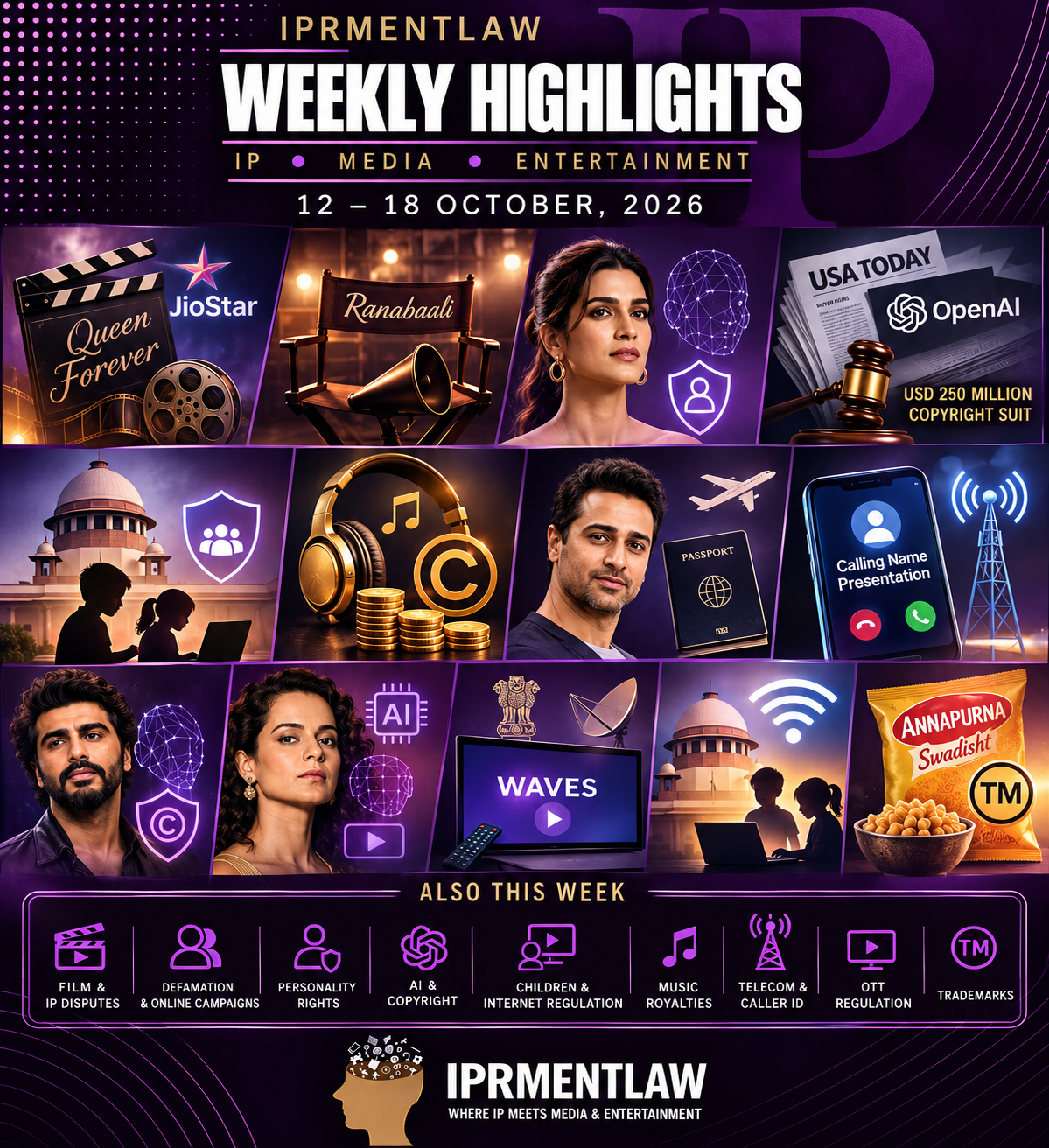
The Bombay High Court declined to grant interim relief against JioStar in a dispute concerning the proposed film Queen Forever. Phantom Studios has instituted a ₹250 crore suit claiming joint intellectual property rights in the film Queen and challenging JioStar’s proposed production. The Court refused to restrain JioStar from proceeding with the project at the interim stage.
Bengaluru Court Grants John Doe Injunction in Favour of ‘Ranabaali’ Producers
A Bengaluru Court granted an ex parte interim injunction in favour of Mythri Movie Makers, the producers of Ranabaali, restraining identified defendants and unidentified persons from publishing or circulating allegedly false and defamatory content concerning the film. The proceedings relate to allegations of coordinated online campaigns, manipulated ratings and negative publicity ahead of the film’s release. The matter is scheduled for further hearing on 6 November 2026.
Delhi High Court Hears Kriti Sanon’s Plea for Protection of Personality Rights
Actress Kriti Sanon approached the Delhi High Court seeking protection against the unauthorised use of her name, image, likeness and identity, including through AI-generated content and digital impersonation. Justice Purushaindra Kumar Kaurav directed her counsel to submit relevant judicial precedents and research material in support of the relief sought. The matter is listed for further hearing on 29 October 2026.
USA Today Files USD 250 Million Copyright Infringement Lawsuit Against OpenAI
USA Today Company and its affiliated newspaper publishers have filed a lawsuit against OpenAI before the United States District Court for the Southern District of New York, seeking over USD 250 million in damages for alleged copyright infringement. The publishers allege that OpenAI used copyrighted news articles, including paywalled content, without authorisation to train ChatGPT. The complaint also alleges that ChatGPT reproduces or summarises protected reporting, affecting publishers’ website traffic and advertising revenue. The plaintiffs have sought monetary damages and injunctive relief.
Supreme Court Seeks Centre’s Response on Regulatory Framework for Children’s Social Media Use
The Supreme Court issued notices to the Central Government and the National Commission for Protection of Child Rights (NCPCR) on a public interest litigation seeking a comprehensive regulatory framework to protect children from risks associated with social media. A Bench comprising Chief Justice Surya Kant and Justice Joymalya Bagchi considered the petition seeking mandatory age verification, parental consent and age-based restrictions on social media access. The matter has been tagged with a pending petition and is listed for hearing on 7 December 2026.
Government Reportedly Examines Regulation of Music Royalty Rates Under Copyright Act
The Ministry is reportedly considering the regulation of music royalty rates under the Copyright Act, 1957. The proposal concerns the determination of royalties payable for the use of copyrighted musical works and sound recordings. The development relates to licensing arrangements involving copyright owners, copyright societies, broadcasters and other commercial users of music.
Actor Imran Khan Challenges Leave India Notice Before Bombay High Court
Actor Imran Khan approached the Bombay High Court challenging a notice issued by the Foreigners Regional Registration Office directing him to leave India by 28 October 2026. Khan, a United States citizen holding an Overseas Citizen of India registration, has challenged the notice on grounds including the absence of a prior hearing and alleged non-compliance with statutory procedures. He has sought quashing of the directive and interim protection against deportation and other coercive measures.
Government Directs Implementation of Calling Name Presentation from 1 November 2026
The Department of Telecommunications has reportedly directed telecom service providers to implement Calling Name Presentation (CNAP) from 1 November 2026. Under the proposed implementation, the registered name of a caller will be displayed alongside the telephone number on supported 4G and 5G networks. The measure is intended to facilitate caller identification and reduce fraudulent and unsolicited communications.
Delhi High Court Grants Permanent Injunction Protecting Arjun Kapoor’s Personality Rights
The Delhi High Court decreed actor Arjun Kapoor’s suit concerning the unauthorised commercial exploitation of his personality rights, including through AI-generated deepfakes, synthetic voice cloning and unauthorised merchandise. Justice Purushaindra Kumar Kaurav granted a permanent injunction restraining the defendants from commercially exploiting the actor’s name, image, likeness, voice and persona without consent. The Court also directed intermediaries and domain registrars to remove identified infringing content upon notification.
Delhi High Court Protects Kangana Ranaut’s Personality Rights Against AI Deepfakes
The Delhi High Court granted interim protection to actor and Member of Parliament Kangana Ranaut against the unauthorised use of her name, image, voice and other personality attributes. Justice Vikas Mahajan restrained the dissemination of AI-generated deepfakes, manipulated videos, fabricated speeches and false endorsements. The Court directed Meta Platforms to remove the identified infringing content and instructed the Ministry of Electronics and Information Technology and the Department of Telecommunications to take necessary steps for blocking access to identified websites.
Ministry of Information and Broadcasting Opposes Application of Satellite Broadcasting Rules to OTT Platforms
The Ministry of Information and Broadcasting informed the Telecom Disputes Settlement and Appellate Tribunal (TDSAT) that Prasar Bharati’s WAVES OTT platform is not governed by the regulatory framework applicable to satellite television broadcasting. Opposing a petition filed by the All-India Digital Cable Federation, the Ministry submitted that the Guidelines for Uplinking and Downlinking of Satellite Television Channels in India, 2022 do not apply to internet-based streaming services. The Ministry also challenged the maintainability of the petition and sought its dismissal.
Supreme Court Holds That Children Have a Fundamental Right to Access the Internet
The Supreme Court, while hearing a petition concerning child sexual exploitation and abuse material on social media platforms, held that access to and use of the internet constitutes a fundamental right under Articles 19(1)(a) and 21 of the Constitution. A Bench comprising Justices J.B. Pardiwala and K. Vinod Chandran observed that blanket restrictions on children’s internet access were not an appropriate solution. The Court suggested safeguards including parental consent, child-specific accounts, restrictions on communications from unknown adults and enhanced content moderation. It also directed the Central Government to provide information regarding technological measures adopted by intermediaries to detect and remove exploitative material.
Madras High Court Modifies Interim Injunction in ANNAPURNA Trademark Dispute
The Madras High Court reportedly modified an interim injunction in a trademark infringement dispute involving Annapurna Swadisht. The Court permitted the continued sale of certain packaged snack products while maintaining restrictions on the use of the disputed mark in relation to specified competing products.