


About Author: Sumati Narayan, IP enthusiast working at Raval & Trivedi Associates, Ahmedabad.
Introduction
“Greatness is not some rare DNA strand. It’s not some precious thing. Greatness is no more unique to us than breathing. We’re all capable of it. All of us.” (Source: YouTube)
In Jerry Maguire, Tom Cruise’s iconic sports-agent character captures his footballer client’s demand: “Show me the money!” while negotiating his contract over the phone. It underscores an attractive commercial opportunity in licensing his image rights. Today, however, the widespread application of internet technology has shifted the focus to “Show me the person”,highlighting thecommercial viability of athletes whose names, likenesses, voices, and personas are routinely appropriated across advertising, artificial intelligence, gaming, and social media.
Every champion has the power to inspire future generations through their personality, image, reputation, and social cohesion. An athlete’s persona makes them a distinct, independent, marketable asset in the sports economy. However, advancements in the technological environment have enabled the misuse of identity through digital platforms and tools, including artificial intelligence, creating deepfakes, fantasy sports, and AI cloning. The personality rights of athletes encompass various attributes that identify them individually. Although personality rights have traditionally developed within the broader domain of privacy and individual autonomy, they are increasingly recognised across jurisdictions as distinct rights possessing significant commercial value.
In India, the absence of a codified statutory framework in protecting the personality rights of athletes has led to the unauthorised commercial exploitation. The need for a statutory framework will become a sine qua non for protecting the sports person’s valuable goodwill in India, wherein the athletic persona is protected to stop illegal interference by third parties and help them restore the full enjoyment of their image rights. Such a framework must be grounded in the principles of transparency, accountability, integrity, autonomy, and participation.
The Modern Athlete Beyond the Playing Field
In the middle of June this year, millions worldwide watched the FIFA World Cup. While excitement at the stadium roared high, it was hardly unusual for two friends to engage in light-hearted debates over whether Lionel Messi remains “the G.O.A.T”. It signals more than an ordinary sporting rivalry. The conversation revolves around Messi’s identity, reputation, and enduring public persona rather than merely his performance statistics. Such interactions demonstrate that an athlete’s commercial and cultural value today is increasingly embedded in their personality, making identity itself a marketable asset. Consequently, modern sports governance must address not only the regulation of athletic performance but also the protection and commercialisation of athlete personality rights.
An athlete’s journey does not end at the finish line, nor does it remain confined to competition integrity, anti-doping, or contractual regulation. What matters more than medals is how intellectual property intersects with personality rights through a player’s endorsement, sponsorship, and merchandising, affecting the economic value of an ‘individual’s identity’. The personality theory of IPR, as propounded by Hegel, provides a foundation for recognising athletes’ personality rights within intellectual property law. For Hegel, personality develops through an individual’s relationship with and control over external objects, allowing the individual to express and manifest their will in the external world. An athlete’s public persona becomes significant because it embodies aspects of their identity and individuality, which should not be distorted without consent.
Formulating a Statutory Code on Sports Personality
During December 2025, the High Court of Delhi in Sunil Gavaskar v. Cricket Tak (CRICKETTAK557) and Ors., CS (COMM) 1329/2025, seeking an injunction for infringement of copyright, performer’s rights, misappropriation of personality and publicity rights, unfair competition, and passing off (Paragraph No. 20). The Court held that unauthorised use of Gavaskar’s name, image, likeness, and signature for commercial gain is violative of the personality rights of the sportsperson (Paragraph No. 32). The relief of an injunction, on finding a prima facie case, irreparable injury to Gavaskar, and the balance of convenience in favour of Gavaskar led to the passing of the injunction and the issuance of John Doe orders against potential infringers (Paragraph No. 37). Similarly, the Court granted injunctive relief in the case ofGautam Gambhir v. Ashok Kumar/John Doe & Others [CS(COMM) 287/2026], restraining infringers from creating objectionable and infringing online content, including misuse through artificial intelligence and deepfake technology (Paragraph No. 50). Intermediaries such as Google and Meta platforms were directed to remove objectionable content within 36 hours (Paragraph No. 54).
The Court in Abhishek Sharma vs. Ashok Kumar & Ors. (CS(COMM) 702/2026), found an original image of Sharma with his manager being manipulated using artificial intelligence, resulting in a misleading AI-generated image (Paragraph No. 26). It recognised that the distinction between defamation and personality rights has been blurred (Paragraph No. 30). In the United States, no federal statute or case law recognises the right of publicity, although federal unfair competition law recognises a related statutory right to protection against false endorsement, association, or affiliation.
Indian law does not currently provide a comprehensive statutory framework governing personality right. In the case of Jaikishan Kakubhai Saraf alias Jackie Shroff v. The Peppy Store & Ors. CS(COMM) 389/2024, the Delhi High Court granted interim protection to the actor’s personality and publicity rights against their unauthorised exploitation (Paragraph No. 16). The Court restrained certain defendants from commercially misappropriating his name, sobriquets, voice and image without his consent, and addressed the unauthorised use of his persona through AI chatbots and digitally manipulated content (Paragraph No. 24). The right to privacy and dignity under Article 21 of the Constitution provides a constitutional foundation, Sections 38, 38A and 38B recognises performers’ rights under the Copyright Act, 1957, protection of goodwill under Section 27 of the Trade Marks Act, 1999, and provisions addressing online impersonation under Sections 66C and 66D of the Information Technology Act, 2000, offer additional avenues of protection.
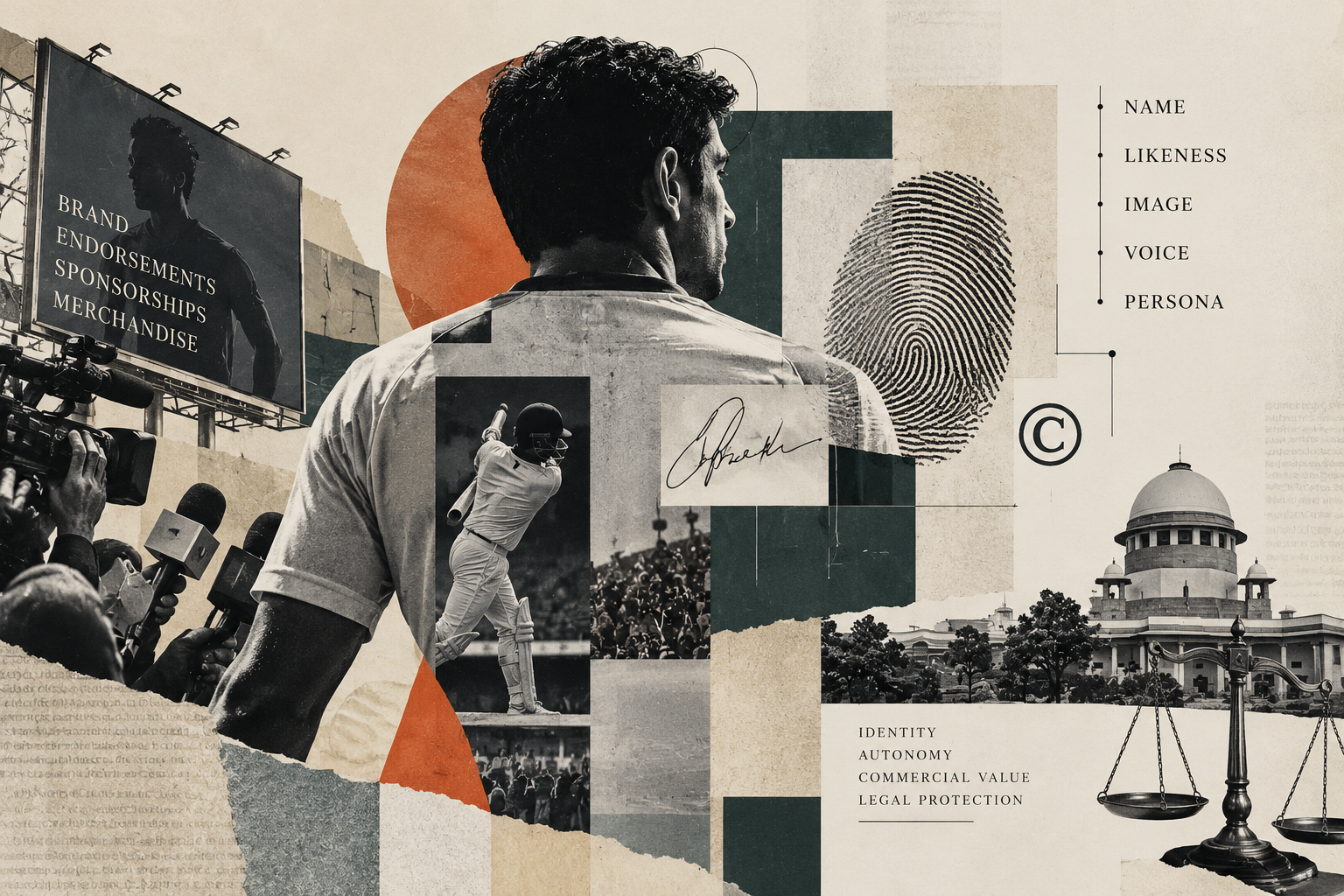
The enactment of dedicated legislation recognising and protecting athletes’ personality and image rights will empower athletes to possess drawing power that gives their identities commercial value. Such legislation should clearly define the scope of “personality rights” to cover an athlete’s name, image, likeness, voice, and other identifiable aspects of their persona, thereby preventing unauthorised commercial exploitation. However, the judicial understanding of publicity rights in India remains unsettled, particularly concerning the class of persons entitled to invoke such protection. In Super Cassettes Industries Pvt. Ltd. v. Dreamline Reality Movies, FAO No. 6386 of 2023, the Court observed that celebrity or publicity rights may be claimed by individuals who have acquired celebrity status and possess a distinct identity associated with commercial goodwill. As Sukhwinder Singh’s celebrity status was neither claimed by him nor asserted by the defendant, the Court declined to recognise a publicity-rights claim on that basis. This approach may be contrasted with Krishna Kishore Singh v. Sarla A. Saraogi, 2021 SCC OnLine Del 3146, where the Delhi High Court observed that the mere status of a celebrity is insufficient and that the foundational facts supporting the asserted rights must be established. These decisions raise an important question: whether commercial publicity rights should be confined to celebrities possessing demonstrable commercial goodwill, or whether the law should also protect the commercial identity of ordinary individuals in appropriate circumstances. The distinction is particularly significant because the absence of a comprehensive statutory framework leaves the scope and limits of personality rights being dependent substantially on judicial development. The legal framework should further recognise a right of publicity, enabling athletes to control and commercially exploit their identity, alongside a right to privacy that safeguards their personal information and private life from unauthorised use or disclosure.
Conclusion
The Olympic motto—”Faster, Higher, Stronger—Together”— reflects the power of sports to unite people across the globe while encouraging athletes to strive for personal excellence. However, athletes are valued not merely for their performances but also for their personalities.
Every fan interaction, endorsement, meme, or online debate reinforces the reality that contemporary sport is driven as much by personality as by performance. The law must therefore recognise that protecting athlete identity is no longer a peripheral commercial concern but a central component of sports governance in the digital era. Protecting athlete personality rights under IPR therefore safeguards more than commercial value: it preserves the athlete’s autonomy, dignity and continuing control over the external manifestation of their personality, while recognising that individual rights must coexist with legitimate societal interests.
A key reform would be to equip our legal ecosystem to recognise personality rights without overshadowing the human dignity of sportspersons. A statutory framework that protects medals while neglecting identities is unethical. It must therefore ensure that the pursuit of excellence is matched by the protection of the athlete’s personality.