




Bonjour,
Comment ça va? (Well … my French exhausts itself almost immediately after this … Alas)
But speaking of things unmistakably French, here’s something I wanted to share and briefly talk about: the 1852 French decree…
‘Twas a decree that would go on to undergird the path of international copyright law and, in many ways, foreshadow the beginnings of the Berne Convention for the Protection of Literary and Artistic Works, 1886 (the first international copyright treaty). Yet it offered nothing new, 19th-century scholars argued.
You may ask: why do I wake a sleeping decree?
Well … so it happened that a few weeks ago, I was leafing through some literature appertaining to early phases of international copyright discourse and noticed that the famed French Decree of 1852 survives in a rather inaccessible form.
The PSCO website’s scanned pages proved the easiest portal to it, though it may require the patience of a legal archaeologist. (A huge shout-out to the project Primary Sources on Copyright (PSOC) 1450-1900 for making a lot of primary recipes available with required context and commentary)
Another way to find it here on pages 259–260 of J. B. Duvergier’s 1852 published Collection complète des lois, décrets, ordonnances, règlements, et avis du Conseil d’État : publiée sur les éditions officielles du Louvre ; de l’Imprimerie nationale, par Baudouin; et du Bulletin des lois, de 1788 à 1824 inclusivement, par ordre chronologique… : suivie d’une table alphabétique et raisonnée des matières. Tis available at the Gallica BnF website.
As I could not find an easily readable text version anywhere, I thought it worthwhile to reproduce the decree here in full both in the original French and in an English translation (using DeepSeek). But whilst dusting off the archival record, I realise that contrary to the exalted status with which this decree is anointed in mainstream discourse, some nineteenth-century commentators greeted it with a more nuanced, and even sceptical, eye. They praised it for its moral might, but they also problematized its much-bandied novelty and moral authority.
‘Twas this forgotten, or perhaps the under-discussed debate, rather than the decree alone, that I wish to discuss in this post. In what follows below, before reproducing the decree verbatim, I share a few reflections on these neglected debates, which seldom find a place in the mainstream telling of international copyright history.
What Nineteenth-Century Scholars Made of It
Long before the age of harmonisation, diplomacy and TRIPS-era sermonizing trade sanctions, France pulled off something rather audacious in 1852 — a decree extending copyright protection to foreign authors without demanding reciprocity in return.
As the accompanying report by Minister of Justice Jacques-Pierre Abbatucci noted, it was an inconsistency and “contrary to universal justice” to protect a foreigner’s physical property in France while leaving their intellectual creations vulnerable to piracy.
At first glance, one may call this move typical of universalist-civilisation logic of the time. But beneath this generosity lay a pragmatic altruism, as some scholars said. By unilaterally protecting foreign works, France positioned itself advantageously in the emerging landscape of bilateral copyright negotiations, securing both cultural prestige and diplomatic leverage.
Alcide Darras, in his commentary, Études théoriques et pratiques de droit international privé. Des droits intellectuels (1887), (page 83), characterised it as marking a shift from mercantilism to universal justice. Reflecting on the decree’s impact, he remarked, in his commentary, that after the Decree of 28 March 1852, the international legal landscape changed entirely. Through this unilateral act of generosity, Darras declared (which I translated),
“France was then able to negotiate not merely as an industrial nation haggling over a tariff with trading nations, but as the sovereign of a moral empire, inviting — and, so to speak, compelling — Europe to sign with her a second declaration of the rights of the intellect.”
And the original French text reads: “Immédiatement après le décret du 28 mars, tout changea de face. Cela devait être; car la France put négocier alors non plus comme nation industrielle marchandant un tarif à des peuples marchands, mais comme souveraine d’un empire moral, conviant, forçant pour ainsi dire, l’Europe à signer avec elle une seconde déclaration des droits de l’intelligence.”
Darras adduced evidence to prove his point (page 83). He noted that while France had managed to secure only four copyright conventions between 1841 and 1852 (when it relied on commercial reciprocity), the moral authority gained from the 1852 Decree allowed it to obtain fifty-seven treaties by 1865. Another 1890 commentary by Lucien Bastide named L’Union internationale pour la protection des œuvres littéraires et artistiques noted that between 1852 and 1857, twenty agreements were entered into (see footnote at page 53).
While often celebrated as the first decree of its kind and the harbinger of modern international copyright law, these scholars have cast doubt on both its novelty and its significance. As Darras, for instance, notes in a footnote (p. 83)
“Even before the 1852 decree came to satisfy the notion of justice in France, its beneficial effects had already been foreseen. Mr Gochut had already remarked in 1839: ‘In matters that must be dealt with in full view of the people, generosity sometimes becomes a matter of tact. A fine example might perhaps have inspired all nations, even those that profit from abuse, whereas a strictly negotiated reciprocity will be accepted only by those states that stand to gain from it’ (Revue des deux-Mondes, Vol. I, (1839), p. 393) During the deliberations preceding the vote on the Franco-Portuguese convention, Mr Barthélémy Samt-Hilaire also said: ‘Once we have begun by declaring that counterfeiting in our country is an offence punishable by law, I believe we shall find it much easier to persuade governments to abolish it in their own countries’ (Moniteur, 30 June–1 July 1851, p. 1852.)”
The Decree that ‘Innovated Nothing’??
More arresting, Lucien Bastide, in his 1890 study of the Berne Convention, offers a characteristic claim that underscores the double-visioned account of the French decree of 28 March 1852. While he acknowledged it as a “monument of law” and a marking of a “new era” in French legal history, he also argued that, from a strictly theoretical lens, it was not a true innovation.
Bastide famously argued that the decree “innovated nothing in reality” and contended that the principle of protecting authors regardless of nationality or place of publication was already legally present in the revolutionary decrees of 1791 and 1793. The 1852 decree merely “sanctioned a situation already legally existing for more than half a century”. (see page 15)
The case of the Law of 19–24 July 1793—often called the “Declaration of the Rights of Genius” and hailed as the “Code of the Rights of Intelligence”—is notable here. The law conferred upon authors, composers, painters, and designers the exclusive right to sell, assign, and exploit their works throughout their lifetime.
Though it said nothing explicitly about foreign authors, to Bastide and Darras, this silence was eloquent… They rather insisted that the 1793 law spoke in a particular universal logic and revolutionary France recognised only frères de l’esprit (“brothers of the mind”).
This meaning, nationality was thus beyond the question. The Revolution had, after all, abolished the droit d’aubaine, the feudal doctrine that allowed the Crown to confiscate a foreigner’s property upon death. In this way, denying protection to foreign authors would amount to a kind of revival of that repudiated injustice, a form of legal spoliation dressed in different clothes.
From this logic, Darras deduced the “true principle” that copyright flowed from the sole fact of creation. As he said, “As soon as the work is born and has appeared to the day, the right to protection is born for the author”.
He believed that the 19th-century courts had “misunderstood” the original breadth of the revolutionary laws, making the 1852 decree necessary to restore those “true principles”. It is in this context that Bastide argued that the 1852 Decree “innovated nothing” but merely restored the spirit of old laws.
The decree found another prominent proponent in the publisher Louis Hachette, one of the principal architects behind the campaign for perpetual literary property. In a letter later cited by Philip Bertocci’s puissant piece, Hachette celebrated the decree’s recognition, “for the benefit of foreigners, in an absolute manner, without condition, of the right of literary property,” because it elevated the issue “to the level of all the great principles of natural law and human rights, instead of reducing it to the petty proportions of a commercial treaty.” In other words, copyright was no longer to be treated as a grubby bargain between trading nations (i.e., through the picnic pole of reciprocity), but as a matter of civilizational principle.
Concluding Thoughts: A French Kiss with Conditions?
It ought not be lost on readers that this French decree came simply out of universal justice. It coincides with France’s growing cultural and publishing dominance. And therein lies the rub: that international copyright was more than a matter of moral enlightenment (which apparently lent it the logic and language). It very much resulted from economic self-interest dominating publishing economies of Europe.
‘Twas a combustible mixture of both (and many other factors I’d say).
It merits mention that the 1858 Brussels Congress on Literary and Artistic Property (arguably, the first international congresses that officially inaugurated the project for international copyright), an assembly of more than 300 delegates, “saluted with respect” the 1852 decree, proclaiming it the “expression of a fundamental truth” and the “living manifestation of a principle of justice too long stifled”. From thereon, it remained a crucial citation in other formative gatherings, especially the 1861 Antwerp Congress and the 1877 Antwerp Congress.
Enough commentary. Let the decree have the last word …
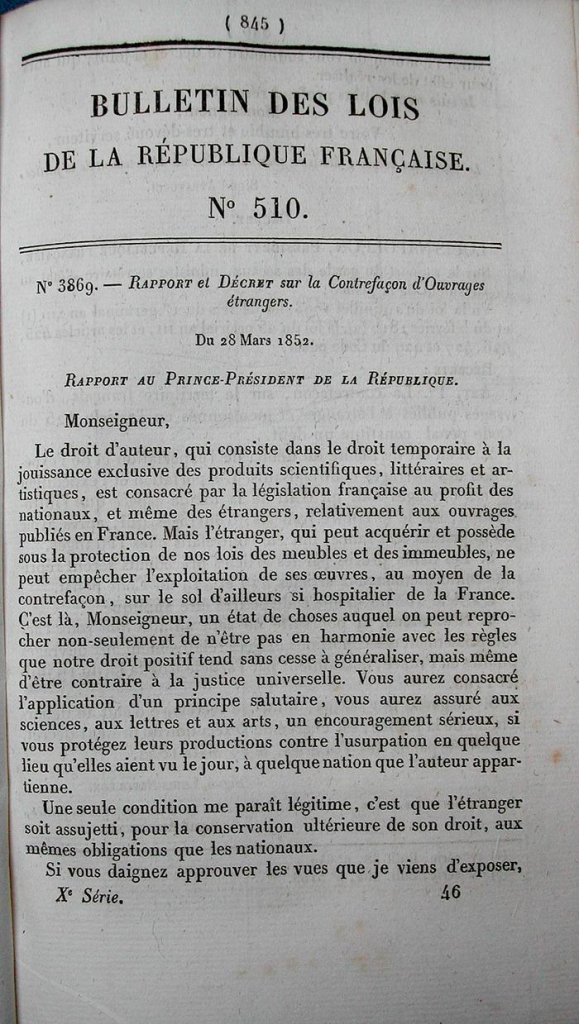
Report and decree on the counterfeiting of foreign works. (X, Bull. DX, n. 3869.)
Report to the Prince-President of the Republic.
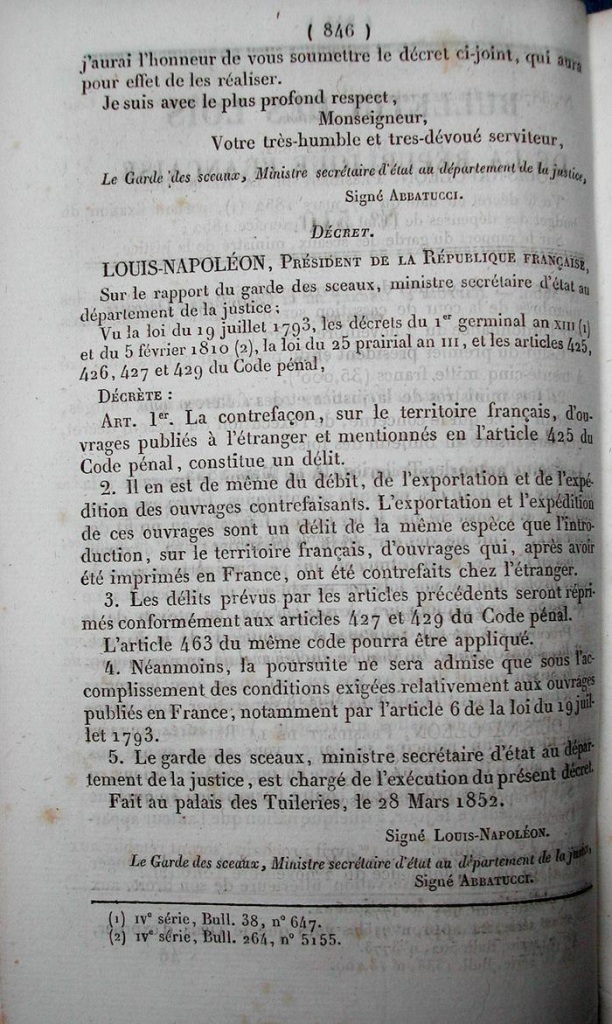
Monseigneur, copyright, which consists of the temporary right to exclusive enjoyment of scientific, literary and artistic products, is enshrined in French legislation for the benefit of nationals, and even of foreigners, with respect to works published in France. But the foreigner, who can acquire and possess movable and immovable property under the protection of our laws, cannot prevent the exploitation of his works through counterfeiting on the otherwise so hospitable soil of France. This, Monseigneur, is a state of affairs which one may criticise not only for not being in harmony with the rules that our positive law constantly seeks to generalise, but even for being contrary to universal justice. You will have consecrated the application of a salutary principle, you will have assured the sciences, letters and arts a serious encouragement, if you protect their productions against usurpation wherever they may have seen the light of day, to whatever nation the author belongs. Only one condition seems legitimate to me: that the foreigner be subject, for the subsequent preservation of his right, to the same obligations as nationals. If you deign to approve the views I have just set forth, I will have the honour to submit to you the attached decree, which will have the effect of realising them. I am with the most profound respect, Monseigneur, your very humble and very devoted servant, the Keeper of the Seals, Minister Secretary of State for the Department of Justice, signed ABBATUCCI.
Decree.
Louis-Napoléon, President of the French Republic, on the report of the Keeper of the Seals, Minister Secretary of State for the Department of Justice; having seen the law of July 19, 1793, the decrees of 1 Germinal year 13 and February 5, 1810, the law of 25 Prairial year 3, and Articles 425, 426, 427 and 429 of the Penal Code, decrees:
Art. 1. Counterfeiting, on French territory, of works published abroad and mentioned in Article 425 of the Penal Code, constitutes an offence.
Art. 2. The same applies to the sale, export and dispatch of counterfeit works. The export and dispatch of such works is an offence of the same kind as the introduction onto French territory of works which, after having been printed in France, have been counterfeited abroad.
Art. 3. The offences provided for in the preceding articles shall be punished in accordance with Articles 427 and 429 of the Penal Code. Article 463 of the same Code may be applied.
Art. 4. Nevertheless, prosecution shall only be admitted subject to the fulfilment of the conditions required with respect to works published in France, notably by Article 6 of the law of July 19, 1793.
Art. 5. The Minister of Justice (Mr Abbatucci) is charged, etc.
Below are the images of the original French text
Thanks to Anshika Tripathi for reading the post.
Image source: https://www.rawpixel.com/search/kissing